
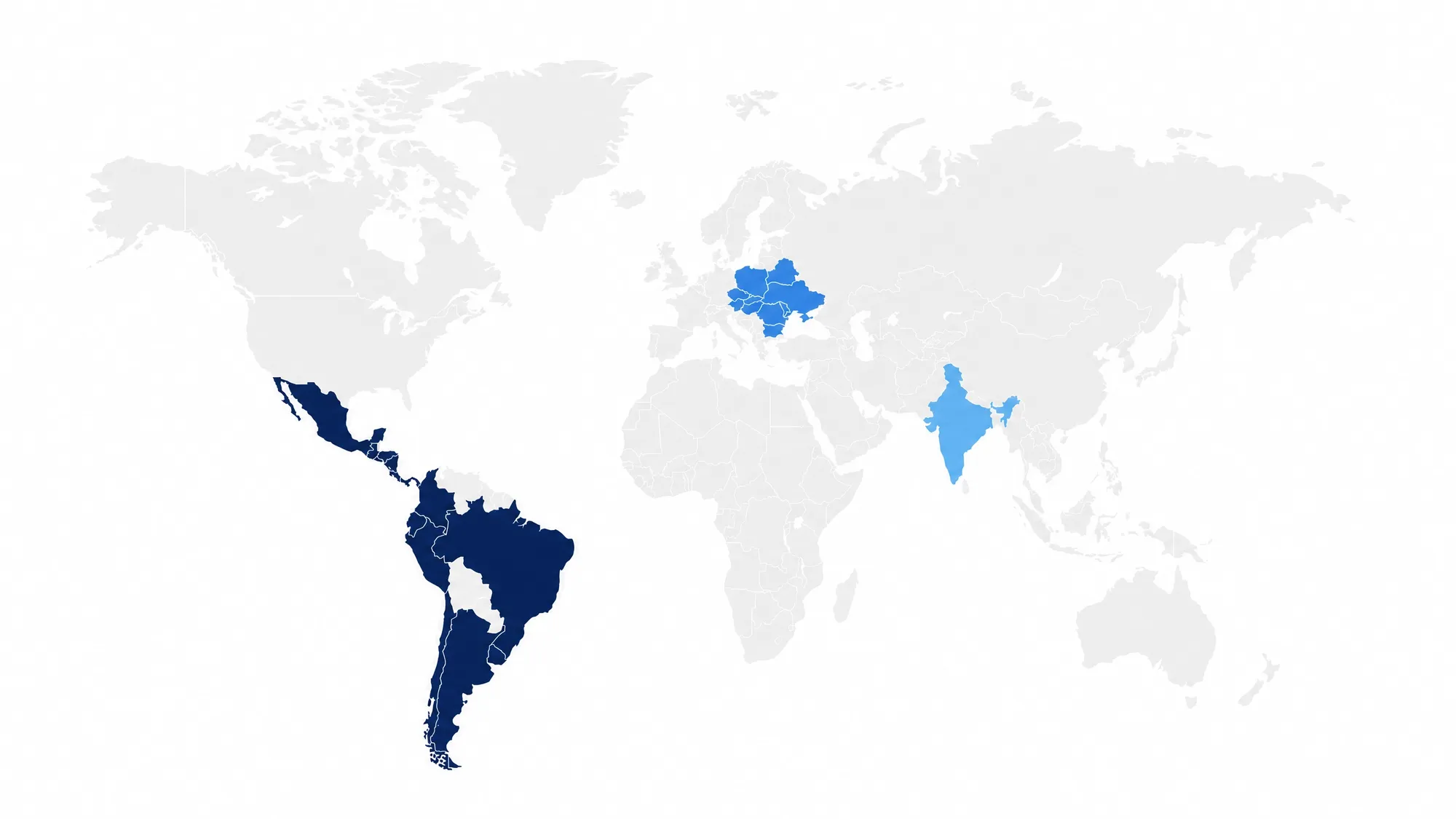
India vs Eastern Europe vs Latin America: Outsourcing Destination Comparison 2026
Choosing an outsourcing destination is one of the highest-leverage decisions a growing business makes — and one of the most misunderstood. Most buyers compare hourly rates and stop there. That's how companies end up with expensive mismatches, timezone chaos, and handover delays that eliminate the savings they came for.
This guide cuts through the noise with a direct comparison of the three dominant outsourcing destinations in 2026: India, Eastern Europe, and Latin America. By the end, you'll know which region fits your service type, budget, and working model — and what the shortlists on generic comparison sites won't tell you.
Why the Destination Decision Has Gotten Harder
Until around 2020, the outsourcing destination conversation was simpler. Eastern Europe (primarily Poland and Ukraine) dominated European buyers looking for nearshore IT talent. Latin America served US-based companies wanting timezone overlap. India handled the broadest mix of services at the most competitive rates.
Post-pandemic shifts have complicated all three regions. The war in Ukraine disrupted Eastern European supply chains and pushed Polish and Romanian rates upward. Latin America saw significant wage inflation in tech as US remote hiring drove demand. India, meanwhile, expanded its talent base — particularly in cloud, AI/ML, and digital marketing — while maintaining its cost advantage.
The result: all three destinations are viable in 2026, but for increasingly distinct use cases. Selecting the wrong region doesn't just cost money — it costs months.
Cost Comparison: What Buyers Are Actually Paying
Hourly rates are a starting point, not a conclusion. Here's how the regions compare across common outsourcing categories:
Software development (mid-level, 3–5 years experience):
| Region | Approx. Hourly Rate (USD) |
| India | $20–$45 |
| Eastern Europe (Poland, Romania, Bulgaria) | $30–$70 |
| Latin America (Mexico, Colombia, Argentina) | $30–$80 |
Source: Accelerance Global Outsourcing Guide
India's cost advantage is consistent and structural — lower living costs, a large graduate supply, and a mature outsourcing industry with established pricing norms. Eastern Europe commands a premium for its proximity to European clients and strong computer science traditions. Latin America sits in the middle, with Argentina and Colombia frequently cited as the best value for US buyers requiring real-time collaboration.
For non-IT services — BPO, accounting, HR, digital marketing — India's advantage widens considerably. Eastern Europe has limited BPO infrastructure compared to India's mature industry, and Latin American BPO is still developing outside of Colombia and Brazil.
Talent Depth: Where the Skills Actually Are
Cost is only meaningful if the talent exists at scale. Each region has genuine strengths and real gaps.
India has the broadest talent base of the three. With over 5 million STEM graduates annually India produces engineers, designers, marketers, and business process professionals at a scale neither Eastern Europe nor Latin America can match. This depth matters when you're hiring teams — not just individuals. Finding 10 qualified React developers in Bangalore or Noida is straightforward. Finding 10 in Warsaw takes longer and costs more.
India's particular strengths in 2026: cloud infrastructure (AWS, Azure, GCP), Python and Django development, mobile app development, digital marketing (SEO, PPC, content), ERP implementation, and BPO/customer support operations.
Eastern Europe punches above its weight in certain technical disciplines — particularly cybersecurity, embedded systems, game development, and complex backend engineering. Countries like Poland and Romania have produced strong fintech and SaaS engineering talent. The depth is real but narrower. For niche engineering roles, Eastern Europe can be the right call. For volume hiring across mixed disciplines, it isn't built for that.
Latin America has grown substantially in full-stack web development, UX/UI design, and product management over the past five years. Colombia and Mexico have invested in tech education programmes, and the region benefits from cultural proximity to US companies. Where it still lags: deep enterprise IT (SAP, Oracle, large-scale ERP), large-scale BPO operations, and emerging tech specialisations like AI/ML engineering at scale.
Time Zone Compatibility: The Hidden Productivity Cost
This is where many buyers make a quiet mistake. They evaluate talent quality and cost, then discover six months in that async-only working is eroding their output.
India (IST, UTC+5:30) has a significant timezone gap with US-based buyers — roughly 9.5–12.5 hours depending on the US timezone. For European buyers (UK, Germany, Netherlands), the gap is 4.5–5.5 hours, which allows a 2–3 hour overlap window in the morning.
This gap is not a deal-breaker — India's outsourcing industry has 30+ years of experience managing it through structured handoffs, thorough documentation practices, and flexible working hours. Established Indian vendors are built for async. The challenge arises with buyers who expect real-time collaboration throughout the day.
Eastern Europe is the closest match for European buyers, with 0–2 hour differences from Western European timezones. For UK and EU companies, this is nearshore in everything but name. US buyers face the same challenge as with India — though Eastern European engineers often work late-shifted hours to accommodate US clients.
Latin America offers the best timezone alignment for US-based buyers, with 1–3 hour differences across most of the continent. For companies that value daily standups, real-time Slack communication, and same-day turnaround, this is a genuine advantage. For European buyers, Latin America is actually the hardest timezone to manage — 4–6 hours behind, with very little overlap during standard working hours.
Communication and Collaboration: Beyond English Proficiency
All three regions have strong English in their professional outsourcing workforce, but the collaboration experience differs in meaningful ways.
India's outsourcing industry has deep experience with Western business culture, structured project management (Agile, Scrum, PRINCE2), and client communication protocols. The largest Indian IT firms set the template that most mid-sized vendors now follow. Communication is formal, process-driven, and document-heavy — which suits enterprise buyers but can feel slow for early-stage teams that iterate quickly.
Eastern European vendors tend to operate with a more direct, Western-European style of communication. Feedback is blunt, expectations are stated plainly, and there's less hierarchical structure in day-to-day interaction. For buyers who find structured Indian communication frustrating, this can feel like a relief.
Latin American teams are often described as highly relationship-oriented — collaborative, engaged in the product, and culturally aligned with US working styles. The flip side is that communication can be less process-driven, which requires buyers to maintain tighter project management discipline on their own side.
Risk Factors Buyers Typically Underestimate
Every destination carries risks that don't show up in the hourly rate.
India: Vendor quality variance is the primary risk. The Indian market has hundreds of thousands of registered IT companies — ranging from world-class to non-functional. The vetting problem is real. Buyers who hire from unverified directories frequently encounter portfolio misrepresentation, team size inflation, and high staff turnover. This is precisely why platforms like Outsource From India (OFI) that pre-vet and curate vendors exist — the cost savings only materialise when you're working with a provider that actually delivers.
Eastern Europe: Geopolitical risk (particularly in Ukraine, though talent has dispersed considerably) and rising costs are the two watch items. Rates have moved upward consistently since 2022 as demand outpaced supply in the post-Ukraine displacement period.
Latin America: Currency volatility (particularly in Argentina and Colombia) creates pricing instability. What looks like a fixed contract can shift significantly if invoicing is in local currency. Intellectual property frameworks also vary by country — a factor for product companies handling sensitive code.
When India Is the Right Outsourcing Destination
India wins when three or more of these are true for your business:
- You need to build or scale a team of five or more people across mixed disciplines
- Your primary need is IT services, digital marketing, BPO, or back-office operations
- Cost efficiency is a major factor — you're targeting the commonly cited 60–80% saving vs in-house Western hiring
- Your team can manage a documentation-led, async-first workflow
- You want a destination with a mature vendor ecosystem and decades of proven enterprise delivery
For buyers who want access to India's talent at the cost of zero vetting effort, OFI — Outsource From India — lists only pre-screened Indian service providers across 50+ categories, from software development and digital marketing to BPO and design. Browse verified Indian outsourcing companies across every major Indian city.
Frequently Asked Questions
Q: Is India still the cheapest outsourcing destination in 2026? A: For most service categories, yes. India maintains the largest cost advantage for software development, digital marketing, BPO, and design, particularly when compared to Eastern Europe. Latin America is competitive for US buyers on an hourly basis, but India's depth and scalability make it more cost-efficient for team-level engagements.
Q: Which outsourcing destination is best for a US startup? A: It depends on your collaboration style. If you need real-time availability and cultural closeness, Latin America (Colombia, Mexico) offers the best timezone fit. If you need cost efficiency and team scale, India is the stronger long-term choice. Most US startups eventually land on India once their team grows beyond two or three contractors.
Q: Can I outsource non-IT work to India? A: Yes — and India's advantage in non-IT outsourcing is often underestimated. BPO, HR, accounting, customer support, digital marketing, and content services are all well-established in India, often at significantly lower cost than equivalent services in Eastern Europe or Latin America.
Q: How do I avoid poor-quality vendors when outsourcing to India? A: Vet before you engage. Review portfolios for recent, verifiable work. Ask for client references you can actually contact. Or use a curated platform like Outsource From India (OFI) that pre-screens vendors before listing them — which removes the vetting burden from your side entirely.
Q: Does Eastern Europe still make sense after the Ukraine conflict? A: For many categories, yes. Poland, Romania, and Bulgaria have seen talent inflows from Ukraine and have stable operating environments. For cybersecurity, game development, and niche backend engineering, Eastern Europe remains a strong option. However, rising rates and limited scalability make it a harder case for volume or mixed-discipline hiring.
Conclusion
No outsourcing destination is universally best. Eastern Europe wins on timezone proximity for European buyers and niche engineering depth. Latin America wins on cultural alignment and real-time availability for US companies. India wins on cost, scale, and service breadth — particularly for buyers who need more than one or two specialists.
If India is on your shortlist, the vetting question is the one that separates successful engagements from expensive disappointments. Outsource From India (OFI) exists to answer it — every vendor on the platform has been reviewed before you ever make contact. Browse verified Indian outsourcing companies across IT, marketing, design, and BPO and shortlist with confidence.